An Open & Flexible Solution for Generative Engine Optimization (GEO) and LLM Brand Visibility Tracking
Vendors like Ahrefs (Brand Radar), Semrush (AI Visibility Toolkit), AthenaHQ, Profound, Nightwatch.io, Peec AI, Geopite, and Mangools provide a new mission critical visibility into AI agent visibility for brands. Brand AI Perception Analytics (“BAPA”) by SpadinaBus is an open (and potentially free) flexible alternative to these solutions built on KNIME and BigQuery.
What BAPA Visualizes: The Anatomy of an AI Search Collapse
Below is a sample visualization tracking data over time for a single search prompt: “What is the best microbrewery in Toronto?”
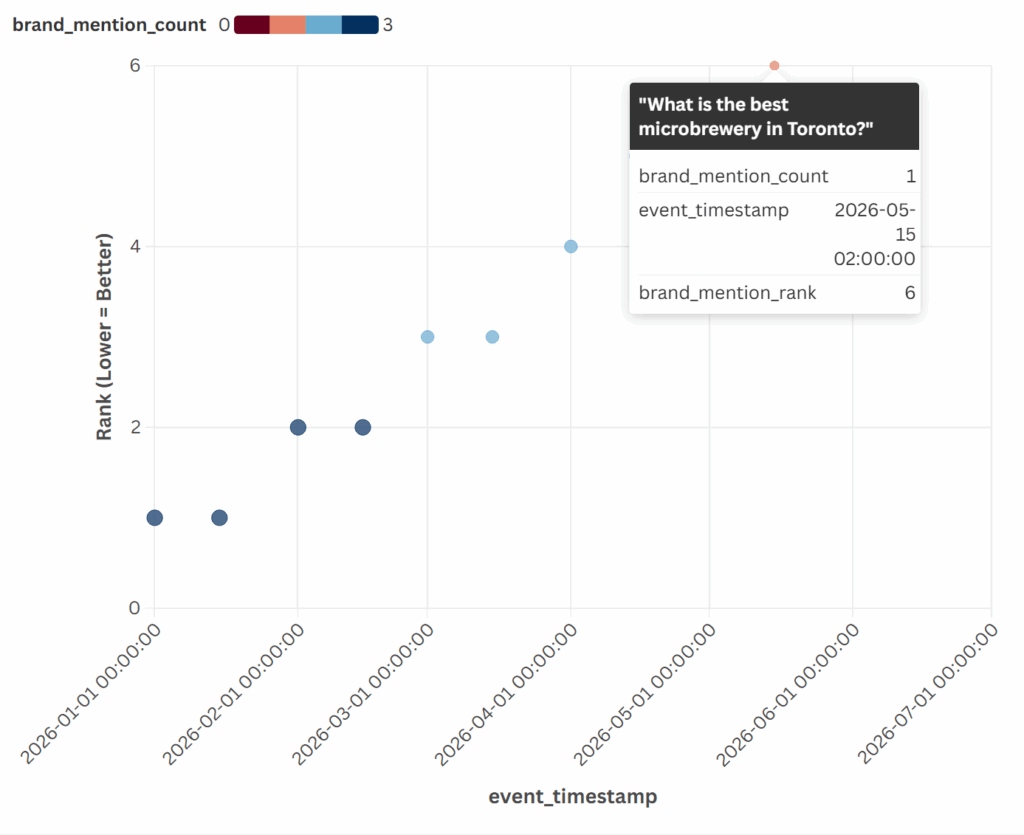
The Strategy Behind the Data: Notice the upward slope? Because Rank 1 is the best, this ascending line actually tracks a massive operational collapse. Early on, the brand was a top recommendation. Over the months, subtle customer service complaints and operational bottlenecks flagged by the LLM caused the brand’s rank to plummet to #6. BAPA automatically escalated this from a “Low” to a “High” operational priority.
Get BAPA and Start Building LLM Brand Intelligence Today
Download the KNIME Analytics Platform today for free, which can run on your desktop:
https://www.knime.com/downloads
Download BAPA from the KNIME Community Hub:
https://hub.knime.com/s/ba65VBSngngc0mFY
How the Engine Works under the Hood
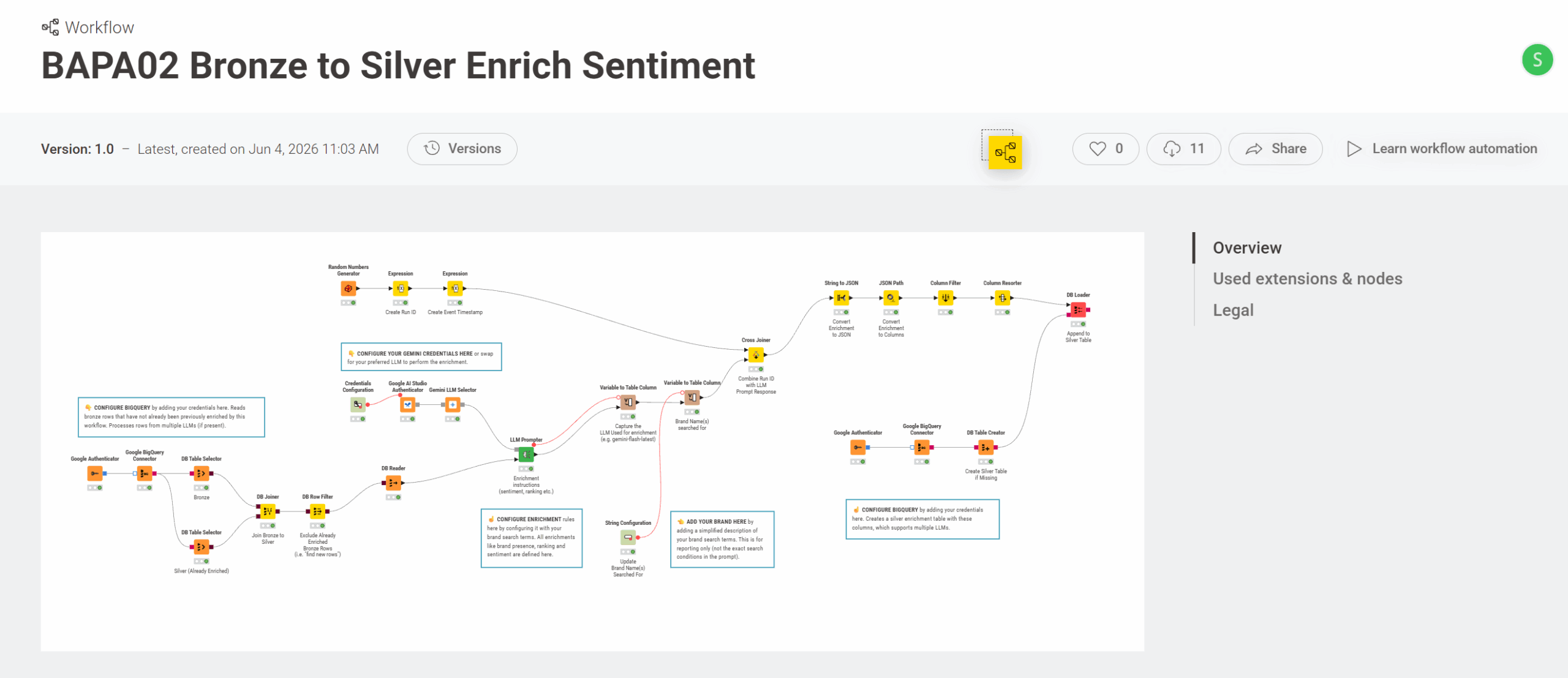
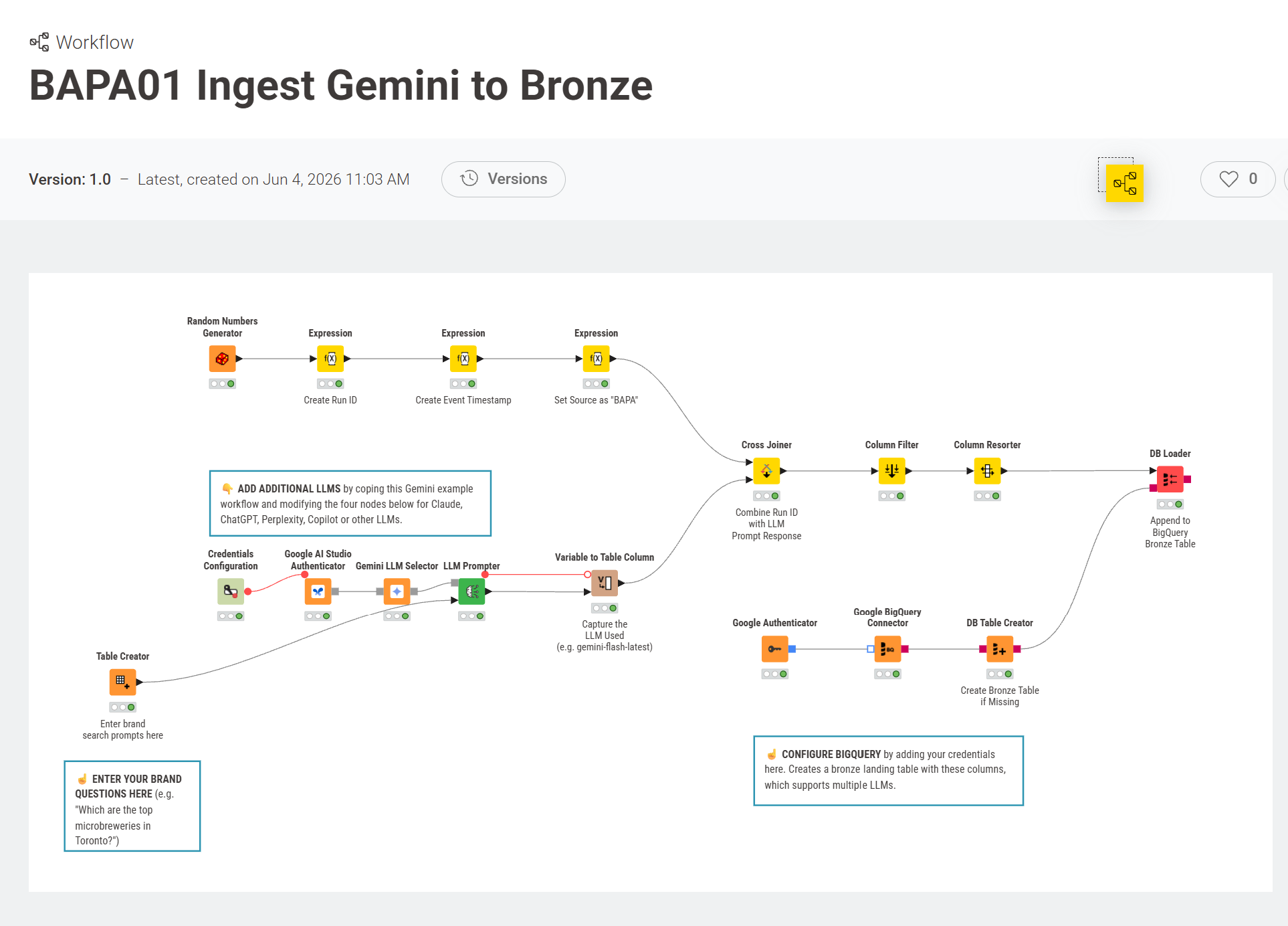
BAPA is engineered using a clean, cloud-native Medallion Data Architecture running on Google BigQuery. It separates raw, un-throttled API log Ingestion from structured downstream enrichment to protect your development budget and scale efficiently.
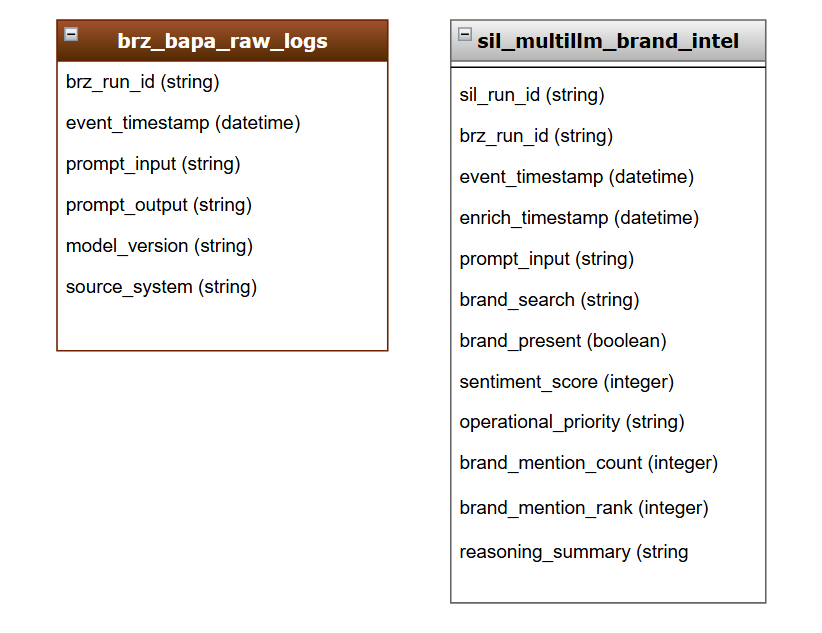
- Bronze Layer (brz_bapa_raw_logs): Automatically captures raw prompt inputs, timestamps, model versions, and raw payload strings straight from one or more AI agent API services
- Silver Layer (sil_multillm_brand_intel): Leverages an LLM-as-Auditor loop to parse the raw text, calculate discrete sentiment scores, establish local recommendation ranks, and output automated qualitative reasoning summaries.
“SaaS AI brand-tracking platforms charge anywhere from $500 to $5,000 per month. They lock you into rigid dashboards, meter your usage, and charge a premium to access data you should already own…”
FAQ
While enterprise tools like Ahrefs Brand Radar, Semrush AI Visibility Toolkit, and BrightEdge offer automated visibility indexing, they limit you to pre-built dashboards and lock your raw data within a proprietary SaaS stack. BAPA functions as an open-source alternative to modern Generative Engine Optimization (GEO) software. Instead of paying a recurring platform tax, BAPA lets you fully own your pipeline. It ingests raw LLM search rankings via desktop KNIME and stores the metrics directly in your own cloud data warehouse, allowing you to bypass the user seats and API lookup limits enforced by premium suites. Optionally, you may consider using KNIME’s commercial offerings, which are designed to meet the needs of larger collaborative teams, and/or the enterprise.
Yes, if your goal is data ownership and infinite custom business logic. Niche SaaS products like AthenaHQ, Profound, Nightwatch.io, Geopite, and Peec AI charge recurring fees to monitor ChatGPT, Gemini, Claude, and Perplexity rankings. BAPA replaces these black-box aggregators by shifting the execution layer directly into your environment. Because it is built visually on the open-source KNIME Analytics Platform, you can completely customize the prompt payloads, inject specific brand-sentiment criteria, and output native tooltips to any BI tool without being forced into a rigid startup UI.
Traditional brand tracking suites cost anywhere from $500 to $5,000 per month. In contrast, running BAPA on the free KNIME desktop client incurs exactly zero platform or software licensing fees. Your only variable expenses are raw API consumption costs from the model providers (such as Google Gemini, OpenAI, or Anthropic) and minimal storage pennies inside Google BigQuery. For light daily delta monitoring or weekly batch audits, your total infrastructure cost will frequently remain well within the cloud provider’s free tiers, lowering your tool maintenance costs to practically zero.
Transitioning from locked-down SaaS suites to BAPA is straightforward because the architecture uses standard Medallion data engineering frameworks. The provided blueprint contains pre-configured ingestion loops that map raw text outputs cleanly into Bronze log tables, while downstream Silver loops handle the automated LLM-as-an-Auditor parsing. If your team is currently bottlenecked by the export limitations or high cost of tools like Mangools AI Search Watcher or HubSpot Content Hub, downloading this visual blueprint gives your enterprise a production-grade data warehouse model that is fully owned, deeply auditable, and instantly ready to scale.
Setting up the BAPA framework requires three basic components, all of which can be initiated on completely free tiers. First, you need the free desktop version of the KNIME Analytics Platform to execute the pipeline. Second, you need a Google Cloud Platform (GCP) account to initialize a Google BigQuery data warehouse; GCP provides a generous free tier of 10 GB of storage and up to 1 TB of query processing per month. Third, you will need a Google AI Studio account for API access to the Gemini API (which offers a robust free tier for low-frequency requests). As your auditing expands to encompass a multi-perspective model evaluation strategy, the pipeline can be easily configured to accept API keys for Anthropic Claude and OpenAI ChatGPT, scaling natively to your enterprise API limits without requiring any code changes.
While BAPA is fully configurable to write data to any modern destination—including Snowflake, Databricks, PostgreSQL, or local files—the framework defaults to Google BigQuery for a highly strategic reason. The vast majority of digital marketers, data analysts, and growth leaders already centralize their ecosystem within BigQuery due to native data streams from Google Analytics 4 (GA4), Google Ads, and Salesforce. Storing your LLM visibility metrics in BigQuery allows you to instantly join AI brand sentiment scores and recommendation ranks with downstream web traffic, organic search click-through rates, and conversion pipelines. This lets you directly prove the financial correlation between your brand’s AI search visibility and actual revenue growth.