
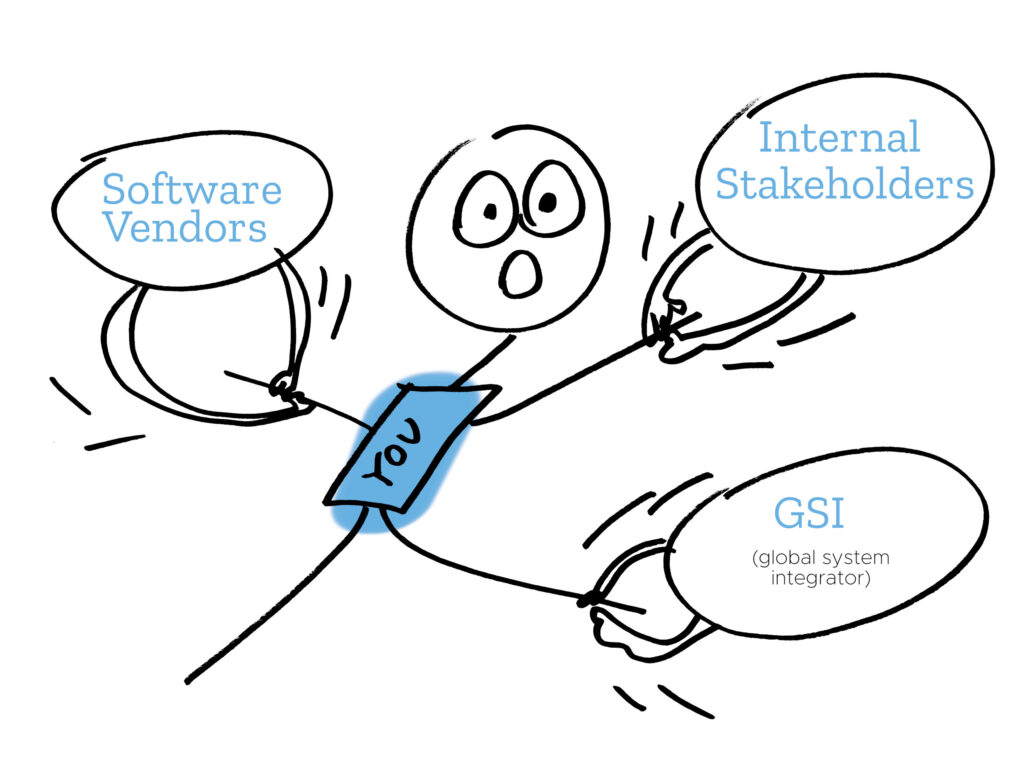
Every VP of Marketing eventually finds themselves pulled in three different directions at once.
To your left, the Software Vendor:
“Our new AI engine optimizes everything out-of-the-box! We just need to expand your license footprint before the end of the quarter.”
To your right, the Global System Integrator:
“We have an 8-person team ready to build a custom framework. Luckily for you, you already have 3,000 pre-approved hours in your budget – let’s start today!”
Above you, your Internal Stakeholders:
“We don’t trust black-box automation, and we’re not giving up control of our campaigns.”
And right in the middle? You.
Trying to figure out who is giving you straight advice, and who is just protecting a quota, billable hours, or internal turf.
When everyone around the table has a hidden agenda, nobody wants to tell you the truth.
So everyone keeps saying things like…
“Well… the vendor said that we’d get a heavy discount if we purchase this additional module…”
“We have a huge budget with our GSI we need to burn, put them on it…”
“IT wants us to use some AI black box…how do we push back?”
An hour of honest, independent advice saves months of wasted budget, vendor runarounds, and political friction that never needed to happen.
That’s the value of having someone in the room who isn’t trying to sell software, maximize billable hours, or defend internal territory.
Sometimes the hardest part of marketing technology projects is knowing who to trust when everyone is pulling you in a different direction.
Read on with “Behind the Sketch” to see how these three pulls played out on the ground – and how an independent perspective cleared the fog.
Behind the Sketch
The Software Vendor
A nationwide points program backed by a full-service marketing and analytics shop was leaning heavily into a new MarTech platform. They were starting to become a strong referenceable customer for how to best implement the stack. Many of the native features were a strong fit for their business.
When the renewal cycle hit, they were aggressively pushed to license a new optimization engine, which came out in the wake of the second “AI winter”. AI was an academic term to be avoided, so vendors framed the solution in terms of the problems it solved (i.e. cross-channel optimization, contact fatigue management etc.).
The problem? The AI solution was never built to accommodate the nature of the client’s unique B2B/B2C relationships. Not only did the user experience not reflect the business reality, but the performance was incredibly poor (jobs would regularly exceed the overnight batch processing window).
Calling out the mismatch early would have been ideal. In this case, I was able to salvage the situation by reducing the scope of the new module’s involvement to 20%, and leveraging the client’s existing IT infrastructure to architect a solution that completed the job in minutes instead of hours, while aligning with their true business reality. The vendor saved face, and the client got what they needed thanks to an independent voice and problem solver.
The Global Systems Integrator
When a Top 5 US general merchandise retailer acquired an enterprise marketing suite, they turned to their trusted GSI – path of least resistance (with plenty of pre-authorized hours available). The GSI was highly skilled in articulating the marketing suite vendor’s high-level vision, but their team lacked hands-on experience building complex operational implementations in the field.
The pre-approved hours were burning fast.
They were locked in a cycle of the GSI parroting the high-level sales pitch from the MarTech vendor, without getting any closer to defining exactly which use cases would be prioritized, and which strategies or goals they would support. This wasn’t obvious, as the MarTech vendor’s success stories were primarily for the finance sector at the time, and translating those stories to retail would require some imagination and creativity.
The fix was for me to run interactive discovery sessions that showcased the “art of the possible”. Having architected systems across banking, high-tech and gaming, I used mock-ups and test data to bridge the imagination gap. After a few sessions with their marketing leaders, they had a sense of what was possible, including some cheeky real-time competitor geofencing scenarios that were likely “too spicy”, but helped them to understand what was feasible. From there, we were able to define a clear menu of use cases to share with executive leadership, with a clear blueprint for how to build, and how they map to business goals.
The Internal Stakeholder
At a Top 5 US insurer, I played the role of translator and peacemaker between IT and marketing. Because I speak both fluently – technical architecture and marketing strategy – IT trusted me to promote the adoption of a new AI-powered MarTech module that had a history of failed implementations and was at risk of becoming shelfware.
The biggest hurdle was the “do less” conversation. To get the most out of the solution, fewer messages would need to be sent to insured customers. All parties knew that this was needed to improve key engagement and revenue targets, but they were paralyzed due to a lack of understanding and trust.
Building that trust and common understanding is something I was able to do by introducing new layers of transparency. I pulled it off with a series of interactive sessions (including a last-minute critical session where I was flown out for a single hour meeting before turning around to fly back home) that showed how business wouldn’t lose any autonomy.
I showed business the levers, the controls, and mock ups of custom reports that would help them visualize where every communication was suppressed, and why. The new module was no longer an opaque “black box”, the paralysis vanished, IT proved the value, and marketing finally had the confidence to execute.
___________________________
Software vendors optimize renewals.
GSIs optimize for utilization.
Internal teams protect ownership.
None of those incentives are inherently bad.
But none of them are the same as optimizing for your business
…
For more sketches, visit spadinabus.com/sketches/.
Or, to join Joe for a ride on his bike, visit spadinabus.com/rides/.