
Every year, thousands of marketing executives return from vendor keynotes with the exact same look in their eyes.
It doesn’t matter what year it is, what software company hosted the event, or what buzzwords were plastered across the main stage. You got jacked up on high-energy techno music, watched motorbikes jump through flaming hoops, ate artisanal tacos from food trucks, and sang along with a washed-up 90s alt-rock band past midnight.
Now you’re back in the office, bellowing out the keynote highlights:
“Real-time”
“Personalization”
“Agentic AI”
“Zero-Copy CDP”
“Customer 360”
And there it sits on the pedestal: the Shiny New MarTech Object, exquisitely engineered, expensively licensed, and waiting patiently for someone to figure out what to do with it.
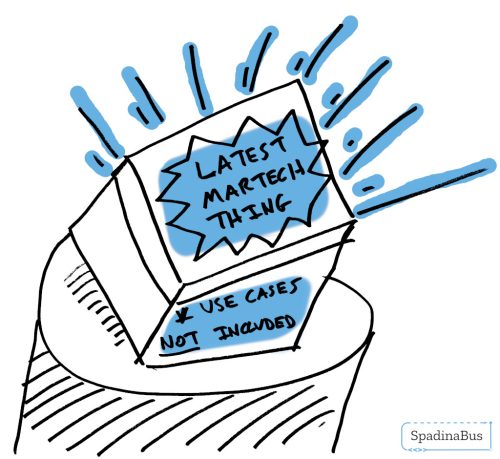
Then the friction starts. You encounter immediate resistance from IT, and your business users look completely bewildered when asked how they are actually going to “do the thing.”
Why? Because you bought into a demo as slick and sexy as Jensen Huang’s leather jacket – without mapping out a single concrete use case, or how any of it fits into your operational reality.
You end up forcing real-time engine capabilities into processes where an overnight batch job works just fine.
You buy a tool with futuristic “agentic” features that sits on top of broken identity resolution and dirty data.
Or worse, you attempt a grand, single-blanket rollout across five different business units whose customers, goals, and regulatory constraints look nothing alike.
Predictably, the platform stalls.
The license fees keep running. And another multi-million dollar tech suite slowly morphs into high-tech shelfware.
The goal isn’t to figure out how to use all of the features you bought.
Unlocking that value doesn’t require another software upgrade. It requires stepping back from the vendor hype, mapping out which capabilities are actually worth using, for which problems, for which internal teams, and why – a “North Star”.
Behind the Sketch
North Star Journey
One of the world’s most recognizable non-profit organizations had recently acquired a massive marketing technology suite when they sought my help with an adoption roadmap. After a series of interviews with multiple business areas, I drafted a “North Star Journey” on a single canvas – an ambitious superset of the most relevant capabilities for each department. This included personalization examples that spoke to the causes most relevant to individual members, including their preferred stuffed animals (sadly, I wasn’t presented with one after the engagement).
The journey wasn’t prescriptive; the intent was to showcase what the suite could do within their enterprise context. Each branch showcased a different set of capabilities with distinct types of customer data. I used the North Star Journey to facilitate discovery sessions that helped draw out new high-value use cases, and define early priorities, and later, a comprehensive roadmap.
Three Business Units & B2B2C Reality
A $40B+ revenue health insurance enterprise had recently purchased an advanced marketing suite, which included AI, 1:1 personalization, and real-time capabilities for both outbound and inbound channels (e.g. mobile & web).
Teams were struggling to identify the right architecture pattern and use cases for this complex business.
What they needed was a whiteboard and a stool sample kit. While (thankfully) no one was actually required to use the stool sample kit, it was a helpful prop to illustrate a patient’s journey and how the latest enterprise marketing solution could improve outcomes.
Rather than offering a blanket solution, I provided use cases and strategies for implementing the product across their three distinct business units, which all had different business objectives: clinical, pharmaceutical, and wellness. Within each departmental workshop, I further fleshed out the ideal use cases by continuously changing the lens of who would benefit most in the three-way matrix central to the business: payer, provider, and patient.
___________________________
Every department has different customers, different goals, different data.
The MarTech features don’t change—it’s just what they’re “there for.”
Map that to strategies, and you get a roadmap.
Skip it, and you get a feature list nobody asked for.
…
For more sketches, visit spadinabus.com/sketches/.
Or, to join Joe for a ride on his bike, visit spadinabus.com/rides/.